Prenatal Multivitamin Strawberry Stick Packs
Prenatal Multivitamin Strawberry Stick Packs
Regular price
$69.95 USD
Regular price
Sale price
$69.95 USD
Unit price
per

HSA/FSA Eligible.
Learn more


Our Women’s Prenatal Multivitamin offers the most nutrient-dense, evidence-backed prenatal ingredients in a convenient and delicious strawberry-flavored stick pack! They deliver the same evidence-based forms and doses of 26 essential vitamins and minerals as our best-selling capsules, providing optimal nutrition before, during, and after pregnancy, with uncompromising quality and flexibility.* Our expert-formulated, third-party tested, and OBGYN-recommended, Prenatal Multivitamin Strawberry Stick packs include essential pregnancy nutrients commonly left out of most prenatals to support both mom and baby.*
1 bag shipped every month

Free shipping on orders over $134
Estimated transit 1-4 business days
Build a bundle to fit your unique life stage + needs and save!
Highlights / Why You’ll Love It:
- Convenience Meets Quality:
Our stick pack is a great alternative for those who struggle to swallow pills, want fewer daily pills, or desire more flexibility in their routine. Unlike powders in a tub, where heavier ingredients may settle and cause inconsistencies in the nutrients you get per serving, individual stick packs consistently deliver accurate nutrient amounts in each serving, so you know you’re getting exactly what you need.
- Mix & Match Formats:
Customize your routine to meet your needs. Whether that’s exclusively stick packs, combining a stick pack with four capsules throughout the day, or adding the option to swap in stick packs to fit your travel plans or on-the-go routine when you need them, it’s easier than ever to get the nutrients you need.
- Refreshing & Delicious:
Our stick packs come in a light strawberry flavor that mixes easily with your favorite cool beverage or food (like yogurt). It’s a refreshing treat that makes it easy to stick to your routine!
- One Formula for Your Whole Journey:
Our Prenatal Stick Pack is designed to simplify your routine across all stages of the perinatal journey, ensuring your nutrient needs are met and preventing unnecessary product switching during an already demanding time.
Details
Details
2 stick packs a day for comprehensive, convenient, and delicious prenatal nutrition. These strawberry-flavored stick packs mix easily with your favorite cool beverages to create a nourishing and refreshing routine that supports you throughout all stages of the perinatal journey.
The right nutrients in the right amounts and formats are crucial for preconception, supporting a healthy pregnancy, especially in the first 4-6 weeks when baby's neural tube is developing, and postpartum recovery. FullWell’s Prenatal Stick Packs deliver 26 optimal, evidence-based forms and doses of nutrients in one potent yet easy-to-tolerate formula. You'll find fertility non-negotiables like folate, B12, and chelated minerals in active, bioavailable forms, plus essential pregnancy nutrients that other prenatals skimp on, like choline, calcium, and magnesium.
- Bioavailable Folate for baby’s heart and neural tube development*
- Choline for baby’s brain, neural tube development, and placental function*
- 4000 IUs of Vitamin D for strong bone development and to boost baby’s immune system*
- 300 mg Magnesium Glycinate for easy and gentle absorption*
- 250 mcg Iodine to support thyroid hormones and overall endocrine health*
- Vitamin B12 for baby’s growth and brain development*
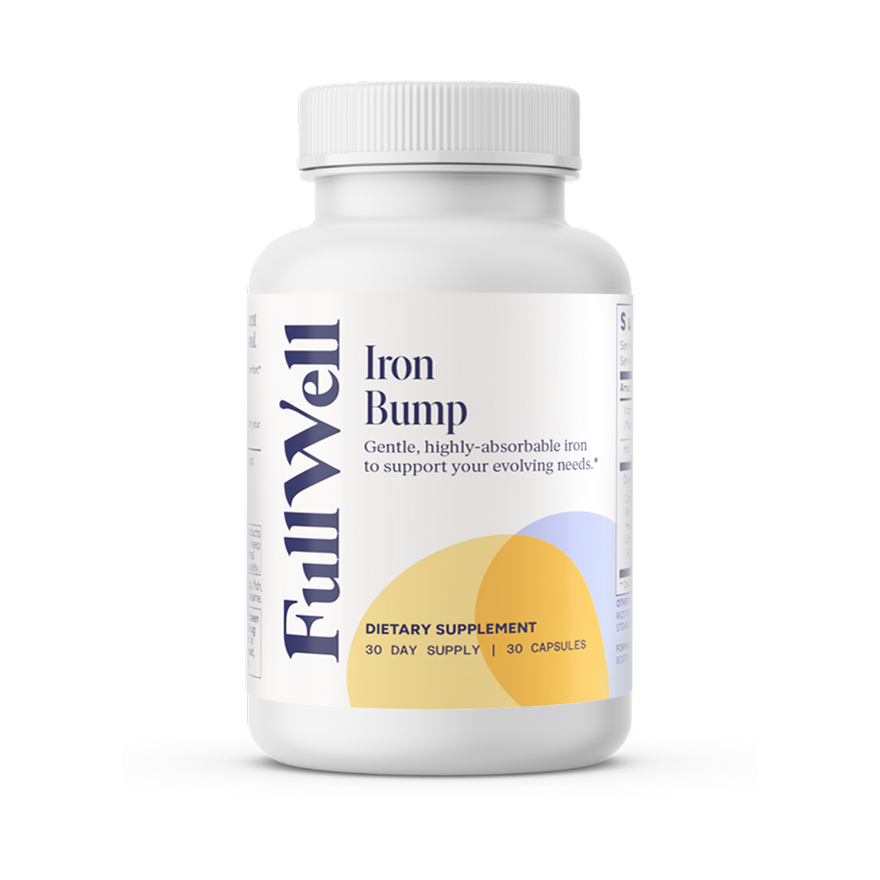
Iron-free formula: There is no one-size-fits-all when it comes to iron needs, with some women not needing iron supplementation at all, while others need doses higher than what many prenatal supplements provide. Our Prenatal is iron-free to provide maximum customizability while also increasing tolerance. Shop our easy-to-tolerate Iron Bump for your individualized needs.
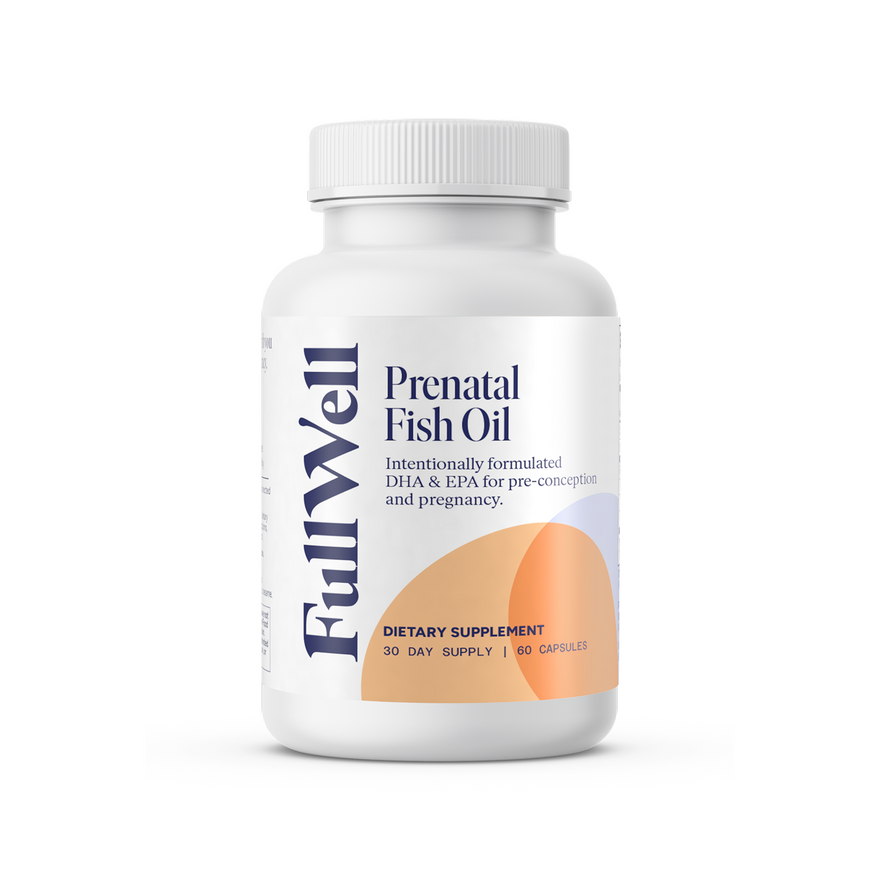
DHA-free formula: While DHA has been extensively studied for its role in supporting brain and visual development during pregnancy and lactation, recent research indicates that EPA is crucial for facilitating DHA's transfer across the placenta, allowing the baby to effectively utilize it. These two essential omega-3 fatty acids are not stable when mixed into a multivitamin, and it's best to take them separately. Shop our Prenatal + Fish Oil Bundle here.
2 Prenatal Stick Packs are equivalent to 8 Prenatal capsules. Stick packs can be taken on their own or used in combination with Prenatal Capsules to fit your routine. If taking both in one day, ensure you consume half the recommended serving of each (eg, 4 capsules and one stick pack).
Made without dairy, eggs, fish, crustacean shellfish, tree nuts, peanuts, wheat, gluten, soy, or sesame.
Testing
Testing
FullWell exceeds current standards by using third-party, independent testing for harmful contaminants - including heavy metals - on every single lot we produce. To see testing results for the most recent lot, please visit our Resources or feel free to reach out to us directly at cs@fullwellfertility.com.


Science-backed prenatal nutrition
Why People Trust Fullwell
Compare our comprehensive prenatal formula against the leading brands across every nutrient, quality standard, and formulation detail that matters.
Prenatal Stick Packs
Meets evidence-backed amounts of nutrient forms and dosing, transparency and quality standards.
Partially fulfills standards on form, dosing, and quality.
Missing, low, or inaccurate ingredient forms or doses; does not adhere to strict and transparent quality standards.
Compare Options
 Stick Packs
Nuance
Servings
Meets standard: Two stick packs/day
One stick pack/day
Format
Format
Meets standard: Stick Packs
Stick Packs
Nuance
Nutrients have different molecule weights. When a powdered supplement is packaged in a tub or gusset bag, ingredients can settle and separate over time, making it challenging to get the amount of intended nutrients per serving. Stick packs solve for this, giving you a precise, consistent dose every time.
Note: Perelel's 1st Trimester Prenatal Powder is not intended to act as a 1 for 1 replacement to their capsules.
Nutrients
Vitamin D3
Meets standard: 4,000 IU
1,800 IU
Nuance
The Hollis & Wagner NICHD study (opens in new tab) published in the American Journal of Obstetrics & Gynecology (2011), showed that 4,000 IU is both safe and the minimum effective dose to maintain sufficient Vitamin D levels during pregnancy, making it the true evidence-based standard in prenatal formulation.
Choline
Meets standard: 300 mg
250 mg
Nuance
Choline is a vital nutrient for pregnancy that supports cell growth, brain development, and the healthy formation of baby's brain and spinal cord, yet approximately 90–95% of pregnant women consume less choline than the recommended daily intake (opens in new tab).* Most prenatal supplements skimp on, or contain none, of this essential ingredient. 300 mg is FullWell's standard amount to help meaningfully close the gap toward the 450 mg daily target most practitioners recommend.
Calcium
Meets standard: 400 mg
Not included
Nuance
Calcium is an essential nutrient in pregnancy, but it's often omitted by brands due to its size and because they choose to prioritize iron instead. Calcium and iron compete for absorption and, including both in the same formula undermines the effectiveness of each. However, iron can interfere with the absorption of other nutrients, and is best taken separately rather than as part of a prenatal multivitamin. At least 200 mg of di-calcium malate (opens in new tab) is essential in a prenatal to help get you closer to your daily requirement (opens in new tab). Di-calcium malate is a highly bioavailable, digestive-friendly form of calcium.
Magnesium
Meets standard: 300 mg
bisglycinate
bisglycinate
100 mg
bisglycinate
bisglycinate
Nuance
Magnesium is a pregnancy workhorse, yet 48% of Americans fall short of the daily requirement (opens in new tab) and 30% of pregnant women taking prenatal supplements still don't meet the requirements (opens in new tab). Over half of pregnant women do not get enough magnesium from diet alone, a dose of 300mg is calibrated to fill that gap while staying under the supplement UL (the Upper Limit specifically for supplements and not including additional magnesium consumed in food). Form matters as much as dose with magnesium to ensure absorption and toleratbility. 100% oxide and carbonate forms are poorly absorbed and notorious for GI upset; citrate absorbs better but can have a laxative effect. Bisglycinate chelate delivers both: superior bioavailability and exceptional GI tolerability, because a high dose of the wrong form is less impactful than the right form at the right dose.
Folate Form
Meets standard: Methylated
1,360 mcg DFE
1,360 mcg DFE
Methylated
1360 mcg DFE
680mcg 6S-5-MTHF Quatrefolic + 680mcg folic acid
1360 mcg DFE
680mcg 6S-5-MTHF Quatrefolic + 680mcg folic acid
Nuance
Folate is one of the most critical nutrients in pregnancy. Folic acid is a synthetic form that a significant portion of women cannot efficiently convert into usable folate due to MTHFR genetic variations (opens in new tab), meaning their prenatal may be delivering far less than the label suggests. Methylfolate and folinic acid mirror what's found in folate-rich foods and are absorbed by every woman, regardless of genetics. That said, if budget is a concern, some folic acid is still meaningfully better than none at all.
B12 Form
Meets standard: Methyl +
Adenosyl
Adenosyl
Methylcobalamin
Nuance
With B12, form matters. Methylcobalamin and adenosylcobalamin are the active forms your cells can readily utilize. When a brand chooses methylcobalamin, and especially when they pair it with adenosylcobalamin, it signals a formulation built around efficacy.
Iron in Multi
Meets standard: Not included
27mg
ferric glycinate
ferric glycinate
Nuance
Iron needs during pregnancy are highly individual. Some women need more, some don't. ACOG guidance (opens in new tab) supports individualized iron supplementation based on actual bloodwork, not a one-size-fits-all dose. Keeping iron out of a prenatal allows you and your provider to dial in exactly what you need, when you need it, without the side-effects and without compromising absorption of other nutrients like calcium that compete with iron head-to-head.
Includes DHA/EPA
Meets standard: Not included
Not included
Nuance
Including EPA and DHA in a prenatal multi is a red flag. Fish oil is highly prone to oxidation and can easily lose potency. Research indicates oxidized oils may have altered biological activity, making them ineffective or potentially harmful (opens in new tab), a risk that increases significantly when oil is bundled into a combined multi rather than protected in a dedicated softgel. Combining them into a multivitamin also sacrifices dosing accuracy. A separate, high-quality, responsibly sourced softgel is FullWell's standard, delivering purity, potency, and flexibility.
Third-party Testing
Published a copy of COA
Meets standard: Yes - located on their website to download with lot number.
Yes - located on their website to download with lot number.
Nuance
A Certificate of Analysis (COA) is the third-party lab document that proves what's on the label is actually in the bottle and confirms the absence of contaminants. A brand confident in their product has no reason to withhold it. If a brand can't, or won't, provide one upon request, there's simply no independent verification behind their quality claims.
Does the COA contain finished-product allergen testing?
Meets standard: Yes, all nine major allergens
COA only includes gluten
Nuance
Even when allergens aren't intentional ingredients, cross-contamination during manufacturing is a real risk that's not worth taking. Allergen testing on the finished product verifies it's actually free from common allergens like gluten, dairy, soy, and nuts.
Heavy Metal Testing Limits Specifications
Meets standard: Prop65
AHPA
Nuance
Heavy metals like lead, mercury, arsenic, and cadmium can enter supplements through raw ingredients and manufacturing, and their impact on fetal neurological development is serious and well-documented. Independent third-party testing is the only way to verify levels are truly safe, but the testing standard matters just as much as the testing itself. California Proposition 65 sets the strictest heavy metal limits in the world. The industry's own AHPA guidelines allow lead levels up to 12x higher than Prop 65, and for a prenatal taken every day throughout pregnancy, Prop 65 is the only benchmark that meaningfully protects both mom and baby.
Data note: Nutrient values are approximations based on publicly available label information and may change. Always verify against current product labels. This comparison is for informational purposes only and does not constitute medical advice. Consult your healthcare provider before starting any supplement regimen.

Ideal Formulation, Real World Results*
- 42% of menstruating users reported improved sleep
- 37% of pregnant users reported less nausea
- The majority of postpartum women in our consumer use study reported feeling more rested while taking the FullWell Prenatal.
*FullWell’s consumer use study included our Prenatal capsules, which feature the same formula and active ingredients as our Prenatal stick packs.
Taking Your Prenatal

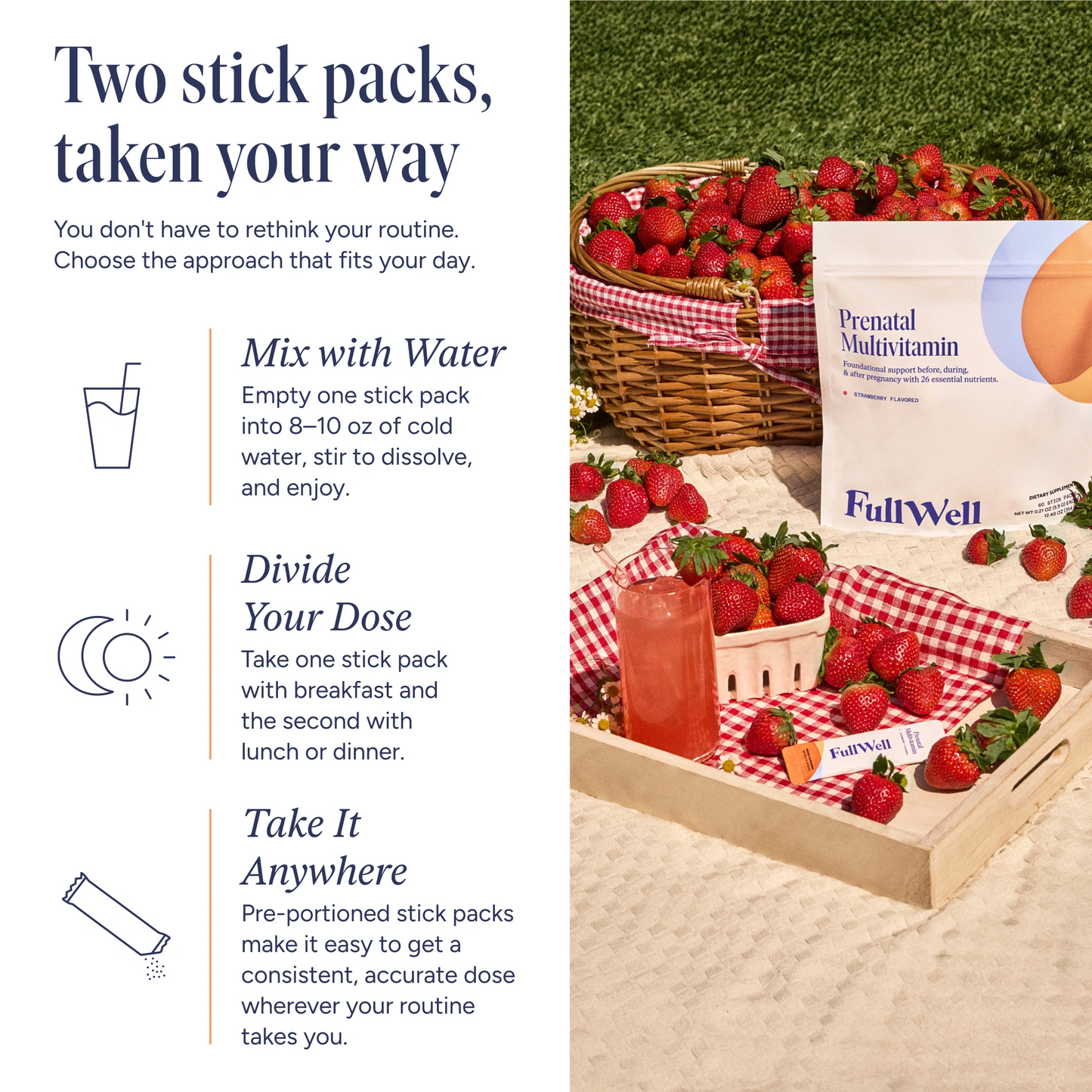
Mix it up
Add one stick pack to a minimum of 8-10 ounces of your favorite cool beverage.

Divide your dose
Take one stick pack with breakfast and the other with lunch or dinner.

Customize your routine
Prenatal Stick Packs can be used alongside our Prenatal Capsules to fit your routine, simply split the serving size of either and combine!
Full Ingredient list
Prenatal Multivitamin Strawberry Stick Packs: Supplement Facts Serving Size 2 Stick Packs (11.8 g) Servings Per Container 30 Amount Per Serving | % Daily Value for Pregnant and Lactating Women Calories | 10 Total Carbohydrate | 4 g | 2%† Dietary Fiber | 2 g | 8%† Vitamin A | 1500 mcg RAE | 115% (as Retinyl Palmitate & Beta-Carotene) Vitamin C (as Ascorbic Acid) | 275 mg | 229% Vitamin D | 100 mcg (4000 IU) | 667% (Vitamin D3, as Cholecalciferol) Vitamin E | 100 mg | 526% (as D-Alpha Tocopheryl Acid Succinate) Thiamin (as Thiamine HCl) | 5 mg | 357% Riboflavin | 10 mg | 625% (as Riboflavin & Riboflavin-5-Phosphate) Niacin | 25 mg NE | 139% Vitamin B6 (as Pyridoxal-5-Phosphate) | 10 mg | 500% Folate | 1,360 mcg DFE | 227% (as L-5-Methyltetrahydrofolate Calcium & Calcium Folinate) Vitamin B12 | 150 mcg | 5,357% (as Adenosylcobalamin & Methylcobalamin) Biotin | 500 mcg | 1,429% Pantothenic Acid | 150 mg | 2,143% (as D-Calcium Pantothenate) Choline (as Choline Bitartrate) | 300 mg | 55% Calcium (as Calcium Lactate Anhydrous) | 400 mg | 31% Iodine (as Potassium Iodide) | 250 mcg | 86% Magnesium | 300 mg | 75% (as Magnesium Bisglycinate Chelate Buffered) Zinc (as Zinc Bisglycinate Chelate) | 20 mg | 154% Selenium (as L-Selenomethionine) | 200 mcg | 286% Copper (as Copper Bisglycinate Chelate) | 0.75 mg | 58% Manganese | 5 mg | 192% (as Manganese Bisglycinate Chelate) Chromium | 120 mcg | 267% (as Chromium Nicotinate Glycinate Chelate) Molybdenum | 100 mcg | 200% (as Molybdenum Glycinate Chelate) Potassium (as Potassium Citrate) | 100 mg | 2% Myo-Inositol | 150 mg | ** Betaine Hydrochloride | 150 mg | ** Vitamin K2 (as Menaquinone-7)(MK-7) | 100 mcg | ** † Percent Daily Values are based on a 2,000 calorie diet. ** Daily Value not established. OTHER INGREDIENTS: CITRIC ACID ANHYDROUS, INULIN, RED BEET JUICE POWDER (BETA VULGARIS) (FOR COLOR), NATURAL FLAVOR, SILICA DIOXIDE, ORGANIC STEVIA LEAF EXTRACT (REBAUDIOSIDE A), ARABIC GUM POWDER (ACACIA GUM). FORMULATED AND DISTRIBUTED BY: FULLWELL LLC, BOSTON, MA 02111 888.366.6563 | FULLWELLFERTILITY.COM
Prenatal Stick Packs FAQs
How do the Prenatal Stick Packs differ from the Prenatal Capsules?
How do the Prenatal Stick Packs differ from the Prenatal Capsules?
The stick pack formula starts with the same nutrient foundation as the original 8-capsule prenatal. All 26 essential nutrients, in the same bioavailable forms and serving sizes. The only adjustments made to the formula are for flavor and solubility: natural strawberry flavor, beet-derived color, organic stevia extract, a more soluble form of calcium, and clean, functional stabilizing ingredients like acacia gum and inulin for mixability.
Why is your powdered prenatal in stick packs rather than a tub?
Why is your powdered prenatal in stick packs rather than a tub?
In any multi-ingredient powder, nutrients vary in density, particle size, and viscosity (how they move). In tubs and bags, these differences cause ingredients to settle and separate over time, accelerated by shipping, time sitting on shelf, temperature changes, repeated opening, and human error impacting scoop consistency. This results in a scooped serving that's never quite the same twice, with some nutrients concentrated at the bottom of the bag or tub, and others at the top. For a general wellness powder, that variability might be acceptable. For a prenatal formula where precise daily intake of key nutrients matters, it isn't. Ensuring the efficacy and quality of every dose of our prenatal reflects our quality standards at FullWell. Pre-portioned stick packs solve this by design, including exactly one serving per stick pack, sealed and protected from the moment it's manufactured. No settling. No scooping variability. No guessing. Just a consistent, accurate dose of all 26 crucial nutrients, every time.
Why doesn't your prenatal contain iron?
Why doesn't your prenatal contain iron?
Iron needs and tolerance vary significantly by individual, and it can interfere with the absorption of other critical nutrients in your prenatal. We suggest you monitor your iron status with your healthcare practitioner, and if you do need supplemental iron, take it separately in appropriate doses at their recommendation. This way, you don’t risk having iron interfere with the absorption of other critical nutrients in your prenatal.
Why doesn’t your prenatal contain Omega-3 fatty acids?
Why doesn’t your prenatal contain Omega-3 fatty acids?
Omega-3s like DHA and EPA can become less potent over time. When they’re included in a prenatal formula, they aren’t protected, meaning their potency and freshness can decline. For that reason, we provide Omega-3s separately in a format designed to better preserve their stability and quality. It also gives you the flexibility to adjust Omega-3 intake based on your personal needs.
Do you use artificial flavors/what are the natural flavors in the Women’s Prenatal Multivitamin stick packs?
Do you use artificial flavors/what are the natural flavors in the Women’s Prenatal Multivitamin stick packs?
The flavor comes from natural strawberry flavor, with beet-derived color and a small amount of organic stevia extract for sweetness. We also include acacia gum and inulin to help the powder mix and dissolve smoothly in water.
Customer reviews
Brand Logos
Skip logos







Related articles