The Truth About Vitamin B6 for Preconception, Pregnancy, and Postpartum
Read more
Not all prenatals are created equal, and when you're taking one daily from TTC through postpartum, the details matter. Knowing what to look for can feel overwhelming, which is why it’s important to understand some of the “green flags” to help guide you. Here's what to look for when assessing prenatal powders:
Because nutrients have different molecular weights, ingredients in a tub can settle and separate, meaning you may not be getting an accurate dose of each nutrient in every scoop. Stick packs solve this by delivering a precise serving every time, no settling, no shifting, and no guessing.
A full ingredient list doesn't tell the whole story. What matters is whether each nutrient is included in evidence-backed amounts and forms your body can actually absorb and use. A few things to check:
A Certificate of Analysis (COA) is the document that proves what's on the label is actually in the product. It should confirm purity and the absence of contaminants, allergens, and heavy metals. Look for testing that covers all nine major allergens, with heavy metals tested to California Proposition 65 standards, the strictest benchmark in the world. These results should be published, easily accessible, and publicly visible on the brand’s website.
Science-backed prenatal nutrition
Compare our comprehensive prenatal formula against the leading brands across every nutrient, quality standard, and formulation detail that matters.
 Stick Packs
Nuance
Nutrients have different molecule weights. When a powdered supplement is packaged in a tub or gusset bag, ingredients can settle and separate over time, making it challenging to get the amount of intended nutrients per serving. Stick packs solve for this, giving you a precise, consistent dose every time.
Note: Perelel's 1st Trimester Prenatal Powder is not intended to act as a 1 for 1 replacement to their capsules.
Nuance
The Hollis & Wagner NICHD study (opens in new tab) published in the American Journal of Obstetrics & Gynecology (2011), showed that 4,000 IU is both safe and the minimum effective dose to maintain sufficient Vitamin D levels during pregnancy, making it the true evidence-based standard in prenatal formulation.
Nuance
Choline is a vital nutrient for pregnancy that supports cell growth, brain development, and the healthy formation of baby's brain and spinal cord, yet approximately 90–95% of pregnant women consume less choline than the recommended daily intake (opens in new tab).* Most prenatal supplements skimp on, or contain none, of this essential ingredient. 300 mg is FullWell's standard amount to help meaningfully close the gap toward the 450 mg daily target most practitioners recommend.
Nuance
Calcium is an essential nutrient in pregnancy, but it's often omitted by brands due to its size and because they choose to prioritize iron instead. Calcium and iron compete for absorption and, including both in the same formula undermines the effectiveness of each. However, iron can interfere with the absorption of other nutrients, and is best taken separately rather than as part of a prenatal multivitamin. At least 200 mg of di-calcium malate (opens in new tab) is essential in a prenatal to help get you closer to your daily requirement (opens in new tab). Di-calcium malate is a highly bioavailable, digestive-friendly form of calcium.
Nuance
Magnesium is a pregnancy workhorse, yet 48% of Americans fall short of the daily requirement (opens in new tab) and 30% of pregnant women taking prenatal supplements still don't meet the requirements (opens in new tab). Over half of pregnant women do not get enough magnesium from diet alone, a dose of 300mg is calibrated to fill that gap while staying under the supplement UL (the Upper Limit specifically for supplements and not including additional magnesium consumed in food). Form matters as much as dose with magnesium to ensure absorption and toleratbility. 100% oxide and carbonate forms are poorly absorbed and notorious for GI upset; citrate absorbs better but can have a laxative effect. Bisglycinate chelate delivers both: superior bioavailability and exceptional GI tolerability, because a high dose of the wrong form is less impactful than the right form at the right dose.
Nuance
Folate is one of the most critical nutrients in pregnancy. Folic acid is a synthetic form that a significant portion of women cannot efficiently convert into usable folate due to MTHFR genetic variations (opens in new tab), meaning their prenatal may be delivering far less than the label suggests. Methylfolate and folinic acid mirror what's found in folate-rich foods and are absorbed by every woman, regardless of genetics. That said, if budget is a concern, some folic acid is still meaningfully better than none at all.
Nuance
With B12, form matters. Methylcobalamin and adenosylcobalamin are the active forms your cells can readily utilize. When a brand chooses methylcobalamin, and especially when they pair it with adenosylcobalamin, it signals a formulation built around efficacy.
Nuance
Iron needs during pregnancy are highly individual. Some women need more, some don't. ACOG guidance (opens in new tab) supports individualized iron supplementation based on actual bloodwork, not a one-size-fits-all dose. Keeping iron out of a prenatal allows you and your provider to dial in exactly what you need, when you need it, without the side-effects and without compromising absorption of other nutrients like calcium that compete with iron head-to-head.
Nuance
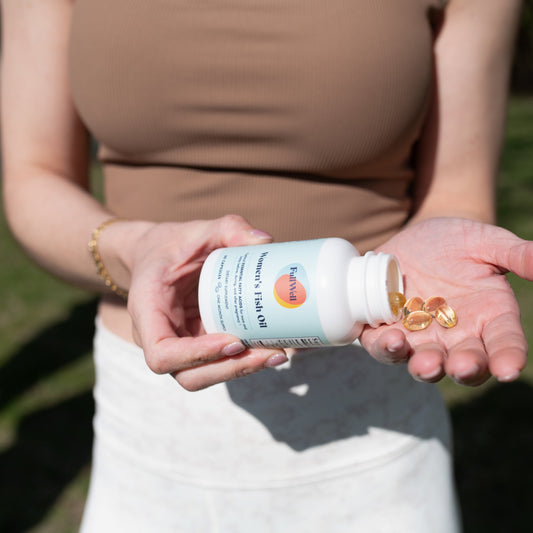
Including EPA and DHA in a prenatal multi is a red flag. Fish oil is highly prone to oxidation and can easily lose potency. Research indicates oxidized oils may have altered biological activity, making them ineffective or potentially harmful (opens in new tab), a risk that increases significantly when oil is bundled into a combined multi rather than protected in a dedicated softgel. Combining them into a multivitamin also sacrifices dosing accuracy. A separate, high-quality, responsibly sourced softgel is FullWell's standard, delivering purity, potency, and flexibility.
Nuance
A Certificate of Analysis (COA) is the third-party lab document that proves what's on the label is actually in the bottle and confirms the absence of contaminants. A brand confident in their product has no reason to withhold it. If a brand can't, or won't, provide one upon request, there's simply no independent verification behind their quality claims.
Nuance
Even when allergens aren't intentional ingredients, cross-contamination during manufacturing is a real risk that's not worth taking. Allergen testing on the finished product verifies it's actually free from common allergens like gluten, dairy, soy, and nuts.
Nuance
Heavy metals like lead, mercury, arsenic, and cadmium can enter supplements through raw ingredients and manufacturing, and their impact on fetal neurological development is serious and well-documented. Independent third-party testing is the only way to verify levels are truly safe, but the testing standard matters just as much as the testing itself. California Proposition 65 sets the strictest heavy metal limits in the world. The industry's own AHPA guidelines allow lead levels up to 12x higher than Prop 65, and for a prenatal taken every day throughout pregnancy, Prop 65 is the only benchmark that meaningfully protects both mom and baby.
Data note: Nutrient values are approximations based on publicly available label information and may change. Always verify against current product labels. This comparison is for informational purposes only and does not constitute medical advice. Consult your healthcare provider before starting any supplement regimen.